Here Comes The Bride
Disclaimer: What I am sharing here comes with a caveat. I am not finished with these thoughts, nor do I feel I have much of a measure of success in always living them out. However, there have been so many outside prompts that I feel it is time to give voice to my thoughts.
The journey to this point (as always), has been multifaceted: A bit here, a picture there, an encounter later all adding in to make a more complete, or perhaps an ever (hopefully) clearer image.
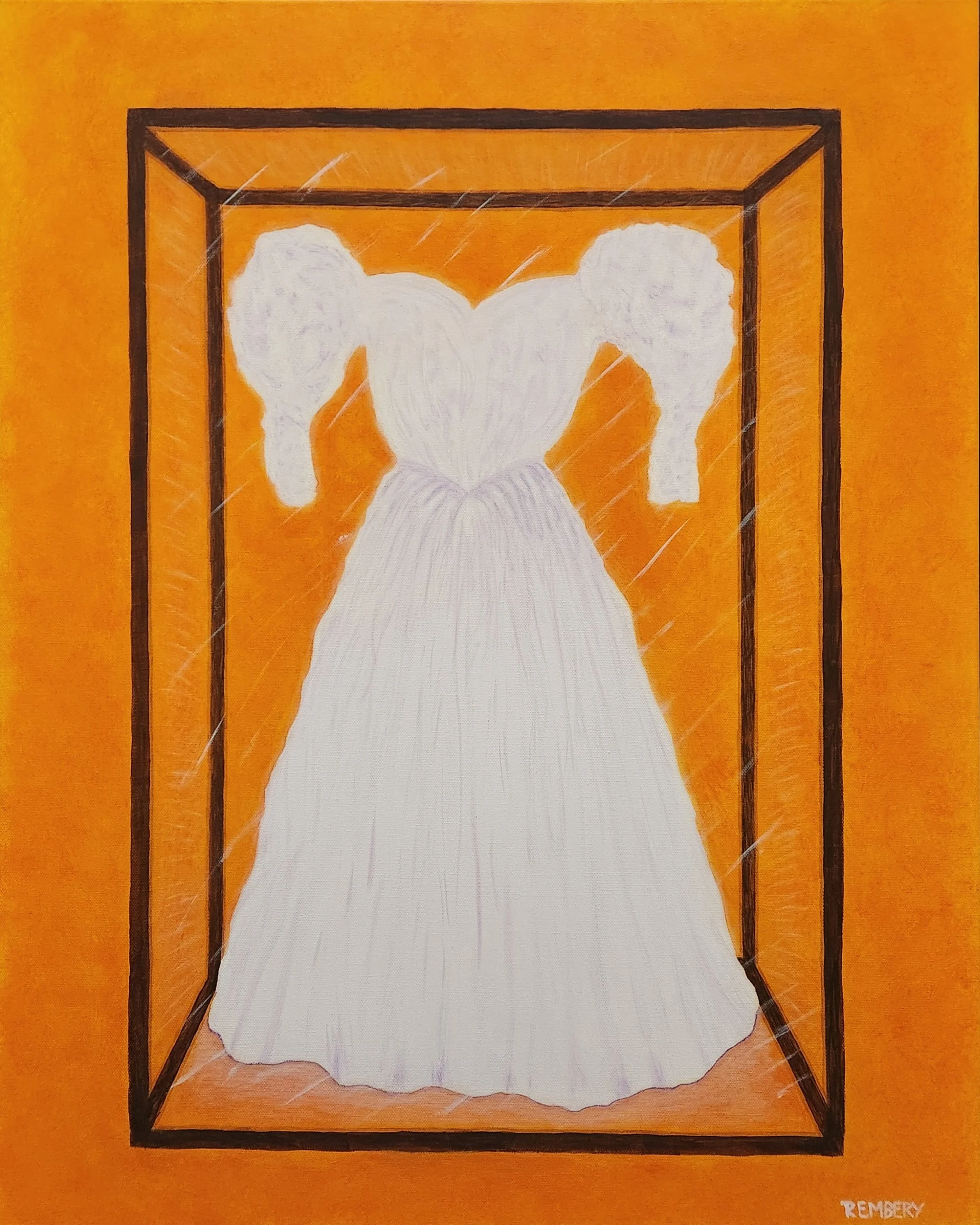
In this case, the overt start of the journey came with a picture I saw some months back in the place between being awake and asleep. It was so strong, I immediately woke up. The image was of a bride’s dress as I have tried to depict in this painting. In my mind’s eye, I saw a wedding dress and it seemed quite crumpled – not in the sense of having been tossed aside, but as in requiring a body to fill it out. As I reflected with Jesus on this dress, I had the sense that He had it kept in a place ready for the Bride to wear it, hence the glass case.
Another prompt emerged over the last few weeks in a couple of ways. The first was on a picnic out in the bush. As we sat eating our meal beside a lovely little river in fairly dry bushland, I suddenly became aware of flowers falling on my head and my plate, and realised there were many on the ground. A bit later, as we hiked up the mountain to a waterfall, once again I became aware of the many flowers fallen on our path. When my attention is drawn to something in the world around me, I usually ask Jesus what it is about, if there is something He wants me to know. I felt there was something about the extravagance of His love, of Him giving to us above and beyond our needs, but it wasn’t landing deeply – I wasn’t feeling the connection to it. I sensed there was something more.
Then, a couple of weeks later, I was out doing some much needed weeding in our garden – also very dry due to the lack of rain over the last month or so. As I knelt to dig out the weeds around one of my rose bushes, I became aware of the many soft petals from the spent roses falling on my head. Immediately, the words “Here comes the bride” came into my mind, and the dots suddenly joined together for me to see the picture. It is perhaps a very western practice, but it brought to mind the flower girl strewing rose petals for the bride to walk on as she comes to meet her groom for the wedding, as well as the practice of throwing rose petals over the bride and groom after the marriage ceremony.
What does all this mean?
The words that came with the image of the wedding dress were that Jesus is looking for a whole Bride, not one that is fragmented, broken and disconnected, fighting over who gets to be the head.
The concept speaks to me of unity and connectedness. This is hardly surprising given the amount of division, disunity and disconnection we see in our world at this time. We all see it and feel it. Unfortunately, most of us (at some point in time) overtly contribute to this division through our words and attitudes about who is “in” and who is “out”, whether that be in a general sense or at a more personal level. When we use terms like “they” or “them” to talk about people who are “other than” those we feel are “like me” we are drawing that line. It is not just happening in the world but in the Body of Christ as well – apparently there are some 46 000 denominations of Christianity at this point of time! That should concern us.
Looking at all the issues, it is easy to wonder if there is any hope for this whole Bride (I see Bride/Body/Church as synonymous) Jesus is looking for. And how do we move toward that given the statistics, not to mention divisive behaviours and attitudes of many if not all of us? (See my disclaimer at the top – I haven’t arrived yet!)
The good news, however, that I felt Jesus remind me is that He is at work in this! He’s not just leaving us to fix the problem. He has answers (is the Answer!?) and He is at work. As part of His body, we get to work with Him on this, to also be part of the solution.
John 17:20-23 is a great starting point for understanding the importance. I know it has been on many people’s radars for some years now. Jesus prayed for all believers, that we would be one even as He and the Father are one. That’s some pretty intense oneness, and not a little challenging to me! However, I get the importance. Imagine a Church that could operate out of at least a small level of agreement. How powerful we would be in being the answer to the one prayer we can all agree on: “Your Kingdom come, Your will be done here on earth as in heaven.”
In a world seemingly filled with division, though, where do we start?
As I looked for some other material more recently, I came across an article that encouraged me greatly about this journey. We are not starting from scratch. Others have done some really hard work before us. Here in Australia, some of the walk towards unity of the Body started at least back in the mid 1800s with the various divisions of the Methodist movement. The leaders came together and decided it was unhelpful to have so many branches and that they would function better if they worked together. And they did unify!
Then, around 1901, when Australia was unifying as a nation, a number of denominations came together with the desire that they should not fall behind the secular – if the nation could come together as one, how much more should the Church? Over the ensuing years, there were many discussions, particularly among the Methodist, Presbyterian and Congregational groups, but unfortunately they struggled to find accord. However, eventually in 1958, the conversation began again, and this time, after nearly two decades, in 1976 the Uniting Church of Australia was born – uniting because the vision was to keep moving forward in this journey of unity. I am also aware of a number of groups working towards connection and unity of the various church communities in their cities and towns. It is exciting to hear of the changes happening in those places.
One of the things that struck me particularly about the journey of the Uniting Church, however, was that those in the discussions acknowledged that to move forward in unity, rather than focus on our differences, we must focus on what we can agree on. (Unfortunately, I can’t find the direct quote.) This seems like a great place to start to me.
I am well aware that there are many even within my own connections who will immediately respond with all the reasons they won’t come into unity with certain others. While it is not my intent or job to convince you otherwise, I will share part of my personal journey that may bring a little shift in perspective.
At a time when I was struggling with the recent breakdown of a church community we were involved with, Jesus spoke His truth deep into my heart, bringing much healing. He said to me, “You are part of My Body. No one else gets to decide that but Me. I decide who is in My Body and who is not. And I say you're in, so you're in and nobody can remove you from there.” A couple of others who knew nothing of what He’d said to me then reiterated this externally. I don’t think this only applies to me, but to anyone who identifies themselves as a believer. In that case, I would rather err on the side of caution when assessing (judging) who is a servant of my Lord and not be too quick to dismiss others because I disagree with them.
Within all of these thoughts, I sense a recurring theme about how we might change what we are doing that is not working. For most of my Christian life, the “Great Commission” has been a central tenet taught and expounded in the church communities I have been involved with. Underpinning it, for me, has been the subtle (and sometimes not so subtle) idea that our best way of thanking Jesus for His gift of life is to tell others about Him so they don’t have to go to hell. This has often even carried undertones, if not said overtly, that if we don’t tell them, we are responsible for them going to hell and we probably don’t love Jesus that much. While people might disagree that this is what is taught, I see many people living out of this belief.
Unfortunately, this focus often leaves the actual commandments Jesus gave us out in the cold. Love God and love one another. The elaboration we see in 1 Cor 13, that anything we do without love, even if we think we are doing it for Jesus (in His Name), is useless and a waste of time (and, I might add, often detrimental to the one on the receiving end). However, other than encouraging me to work harder at loving others and give me ideas of “things to do” to show love, I have heard few messages that help me love others better, especially those I struggle with.
I can’t help but wonder how the Bride might look different and more unified if we could do the loving each other a bit better – especially loving our enemies (Matt 5:44)? Quite possibly, though, the problem lies in our own experiences or lack thereof. How do I love someone else, when deep down, I hate myself, when the messages I have received remind me of how unworthy I am, how useless or unimportant I am, how sinful I am? How do I love myself without having an encounter with Divine Love? 1 John 4 reminds us that we cannot even love God without experiencing His love, and further, if we don’t love each other, we don’t love God either.
But what does love look like?
To me, respect and honour, seeing the other person as created in the image of God, and therefore worthy of love is a good starting place. Treating others as you would like to be treated is another. A major idea that came to me for the next level was to go to those I disagree with and actively listen to them, to find out why they think the way they do, or even what they truly think.
I’m still regularly failing, but each time I fail, I am determined to get up and try again, asking Jesus for His help, for His insights and for His strategies. He is in the process of preparing His Bride – both as individuals and as the corporate Body – so I want to listen carefully for what He specifically wants me to do and how to do it. With Him as our only Head, if we are all listening in, I am sure His choreography is amazing, even with the odd misstep!
I am as aware at this end as at the beginning that this is not a quick and easy fix. I know that the answers aren’t always straightforward or even simple. However, if our focus is on Jesus and being more like Him, exhibiting His characteristics – love, joy, peace, patience, kindness, goodness, faithfulness, gentleness, and self-control – which are already ours to enjoy within our connection to Him, then we will step further and further into the unity of His Spirit.
Jesus is not only looking for a whole (shalom-whole) Bride, but He is actively establishing Her. What next step is He asking you to take in helping build unity in the Body of Christ?